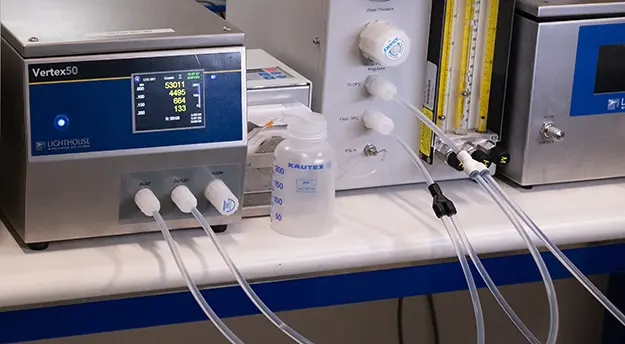
Liquid particle counters (LPCs) come in three main types — standard particle counters, batch samplers, and remote LPCs — and each is tailored for a specific monitoring need in controlled environments. Choosing the right type is crucial for effective contamination control in industries like pharmaceuticals, semiconductors, and more.
Liquid particle counters provide higher sample throughput and are commonly used for quality control, process validation, and compliance testing—often equipped with advanced data logging and connectivity features.
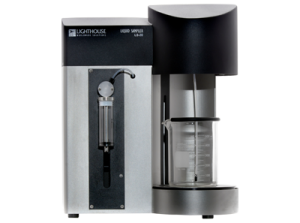
Batch samplers are liquid particle counters designed to analyze discrete samples of liquids. They provide detailed particle size distribution and concentration data for each sample, making them ideal for quality control, product release, and troubleshooting in various industries. Batch samplers offer flexibility in sampling volume and rate, and are commonly used when continuous monitoring is not required or practical. They complement handheld, portable, and inline counters by providing precise, sample-based measurements.
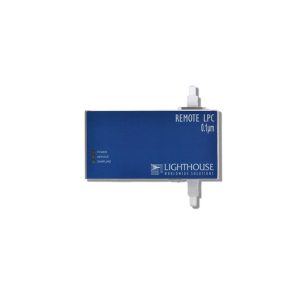
Remote liquid particle counters are designed for continuous, real-time monitoring of liquid streams, delivering automated data directly to centralized monitoring systems.
Explore the details, as well as the advantages and limitations of each type of LPC.
Liquid particle counters are specialized instruments designed to detect and measure particulate contamination in fluids such as water, oils, and pharmaceutical solutions. These devices draw a precise volume of liquid through a sensing zone, using light obscuration or other technologies to count and size particles suspended in the liquid. Liquid particle counters are essential tools for quality control, contamination monitoring, and compliance with industry standards in sectors like pharmaceuticals, microelectronics, and industrial manufacturing.
Accurate detection of a wide range of particle sizes in various liquids
Provides quantitative data to ensure compliance with industry standards (e.g., ISO 21501, USP <788>)
Supports batch sampling and continuous in-line monitoring
Many models offer automated data logging and reporting features
Requires careful cleaning and maintenance to prevent cross-contamination
May need calibration for different fluid types and viscosities
Higher initial investment compared to some basic particle counting devices
Liquid particle counters are best suited for laboratory analysis, process control in manufacturing, and environments where precise monitoring of liquid cleanliness is critical. They are indispensable for applications demanding stringent contamination control and regulatory compliance.
Batch samplers are specialized instruments designed for periodic contamination monitoring in liquids, using automated systems to collect and analyze discrete samples. These devices are essential in industries requiring stringent quality control, such as pharmaceuticals, semiconductor manufacturing, and chemical processing, where they provide precise particulate analysis for regulatory compliance and process validation.
Automation and efficiency: Reduce manual intervention through programmable sampling sequences and automated data logging .
Regulatory compliance: Built-in features ensure adherence to industry standards (e.g., USP, ISO) with audit-ready reporting .
Waste reduction: Minimize chemical consumption through small-volume sampling (e.g., 10% of syringe capacity), lowering operational costs .
Portability: Mobile units enable on-demand spot checks across multiple locations without process interruption .
Accuracy: Advanced bubble suppression and pressurization ensure reliable particle counts in diverse fluids .
Higher initial investment: More expensive than basic manual sampling methods due to complex technology .
Maintenance intensity: Require regular cleaning and calibration to prevent cross-contamination .
Limited real-time capability: Designed for intermittent batch checks rather than continuous flow monitoring .
Operational complexity: Software-dependent systems may necessitate training for optimal use .
Batch samplers excel in environments demanding repeatable, high-precision liquid analysis—particularly in cleanroom validations, parts cleaning verification, and chemical quality assurance—where their automation and compliance features justify the investment.
Remote liquid particle counters (LPCs) are specialized instruments designed for continuous, real-time monitoring of particulate contamination in liquid systems such as pharmaceutical water, industrial process fluids, and ultrapure water supplies. These devices are permanently installed at critical points to provide uninterrupted data collection and immediate contamination alerts, ensuring compliance with stringent industry standards like ISO 21501 and USP <788>.
Real-time contamination control: Continuous monitoring enables immediate detection of particulate deviations, allowing rapid corrective actions to prevent compromised product quality.
Regulatory compliance: Automated data logging and reporting features simplify adherence to pharmaceutical and microelectronics industry standards, with built-in audit trails.
System integration: Seamlessly connects to facility monitoring systems via Modbus, RS-485, or 4-20mA outputs for centralized data management.
High sensitivity: Detects particles as small as 0.1µm, with flow rates standardized at 100 mL/min for precise volumetric analysis.
Durability: Constructed with stainless-steel enclosures and wetted surfaces (e.g., quartz, PTFE) resistant to corrosive fluids and pressures up to 150 PSI.
Higher installation complexity: Requires integration into existing piping/control systems, increasing setup time compared to portable units.
Maintenance demands: Regular cleaning (e.g., Micro90® solution) and calibration are essential to prevent cross-contamination and ensure accuracy.
Cost-intensive: Higher initial investment than handheld alternatives, with advanced models exceeding basic particle counters in price.
Limited mobility: Fixed installation restricts use to predefined monitoring points, unlike portable spot-check devices.
Remote LPCs excel in environments demanding uninterrupted water or fluid quality assurance—particularly pharmaceutical manufacturing, semiconductor fabrication, and critical utility systems—where their real-time analytics and compliance capabilities justify operational costs.
Airborne particle counters are engineered with a suite of advanced features that ensure precise, reliable, and actionable data for contamination control in critical environments. The following key features distinguish modern particle counters and directly impact their effectiveness, usability, and compliance with industry standards.
Particle counters can detect and size particles as small as 0.1 µm, with many models offering multiple user-selectable size channels (commonly 3 to 6 or more), allowing simultaneous monitoring of a range of particle sizes relevant to cleanroom and industrial standards.
Factory calibration at specific size thresholds (e.g., 0.3, 0.5, 5.0 µm) ensures accuracy and repeatability, with some instruments allowing custom channel configuration for specialized applications.
Real-time data display and logging enable immediate detection of contamination events, supporting proactive contamination control and rapid response to excursions.
Data can be viewed in various formats, including tabular, graphical, and trend charts, enhancing the ability to spot patterns and sources of contamination.
Many counters provide both cumulative and differential counts, as well as mass concentration estimates (µg/m³), for comprehensive air quality assessment.
Modern counters feature intuitive, icon-driven color touchscreens, making configuration, navigation, and data review straightforward—even during active sampling.
Large internal memory (e.g., up to 45,000 sample records and 1,000 sample locations) allows for extensive data storage, while USB, Ethernet, and wireless connectivity options facilitate easy data export and integration with facility monitoring systems.
Remote access and diagnostics enable technical support and software updates without removing the instrument from service, minimizing downtime.
Many particle counters include built-in or optional sensors for temperature and relative humidity, providing a more complete picture of environmental conditions and supporting correlation with particle data.
This integration is especially valuable for pharmaceutical, healthcare, and electronics applications, where environmental factors can influence contamination risk.
Compliance with international standards such as ISO 21501-4, ISO 14644-1, and JIS B9921 is standard, ensuring traceable, audit-ready results for regulated industries.
NIST-traceable calibration and recommended annual recalibration maintain measurement accuracy and regulatory compliance.
Counters offer a range of sampling modes, including automatic, manual, real-time meter, cumulative/differential, and mass concentration, to suit diverse monitoring needs.
Adjustable sample times (from 1 second to 99 hours) and programmable alarms for particle counts, flow, and environmental parameters enhance operational flexibility and safety.
Lightweight, high-impact enclosures and ergonomic designs support one-handed operation and easy transport, while internal HEPA-filtered exhaust systems prevent recontamination of the environment.
Long battery life (often exceeding 10 hours) and power conservation modes ensure reliable performance during extended field use.
Modern particle counters are designed for seamless integration with building automation and environmental monitoring systems via multiple communication protocols (USB, Ethernet, Wi-Fi, RS-232/485, Modbus).
This connectivity supports centralized data management, real-time alerts, and comprehensive reporting for compliance and process optimization.
| Feature | Benefit |
|---|---|
| Multi-channel sizing | Simultaneous monitoring of multiple particle sizes for comprehensive contamination control |
| Real-time monitoring | Immediate detection and response to contamination events |
| Advanced user interface | Intuitive operation, easy data review, and configuration |
| Environmental sensors | Integrated temperature and humidity monitoring for holistic environmental assessment |
| Compliance and calibration | Audit-ready results and traceable accuracy for regulated industries |
| Flexible sampling modes | Adaptable to various monitoring scenarios and requirements |
| Robust construction | Durability and portability for field and cleanroom use |
| System integration | Seamless data export and facility-wide monitoring |
These features collectively ensure that airborne particle counters deliver the accuracy, reliability, and compliance required for modern contamination control in cleanrooms, pharmaceutical manufacturing, healthcare, electronics, and beyond.
Data integrity is the cornerstone of contamination control in regulated industries, ensuring that particle count information is accurate, complete, and traceable throughout its lifecycle. For pharmaceutical manufacturing, semiconductor fabrication, and healthcare applications, robust data management isn’t just a best practice — it’s a regulatory necessity.
Airborne particle counters must adhere to stringent global standards, including:
Non-compliance risks costly regulatory actions, product recalls, or facility shutdowns.
| Practice | Implementation Example | Regulatory Alignment |
|---|---|---|
| Periodic Audit Reviews | Quarterly data backups with checksum verification | FDA 21 CFR Part 11 |
| Calibration Tracking | Automated reminders for ISO 21501-4 recalibration | EU GMP Annex 1 |
| Environmental Correlation | Sync particle counts with temp/humidity logs | ISO 14644-1 |
| Root Cause Analysis Tools | Trend graphs pinpointing contamination sources |
1. Secure Data Collection & Storage
2. Compliance-Built Functionality
3. Reporting & Traceability


Lighthouse’s Solair 3100 and ApexZ series particle counters include built-in features to streamline compliance:
For industries where data reliability is non-negotiable, modern airborne particle counters combine advanced monitoring with ironclad data governance — turning regulatory obligations into actionable insights for contamination control.
| Factor | Technical Details | Applications Impacted |
|---|---|---|
| Particle Size Range | Detection capability from 0.1 µm (nanoparticles) to 100 µm (larger debris) | Pharma (0.1–5 µm), Semiconductor (0.05–1 µm), Battery Manufacturing (0.3–10 µm) |
| Flow Rate | 1.0 CFM (28.3 LPM) for routine checks; 50–100 LPM for rapid certification | Cleanroom certification, high-volume monitoring |
| Portability | Handheld (0.1 CFM) vs. portable (28.3–100 LPM) vs. remote (fixed installation) | Spot checks (handheld), continuous monitoring (remote) |
| Data Integrity | 21 CFR Part 11 compliance, audit trails, and encryption | GMP facilities, FDA-regulated environments |
| Environmental Fit | VHP compatibility, HEPA-filtered exhaust, chemical resistance | Isolators, bio-decontamination zones |
Selecting the ideal airborne particle counter (APC) requires a careful balance of technical specifications, regulatory requirements, and operational needs. The process involves evaluating a range of critical factors to ensure optimal performance and compliance in environments where air cleanliness is non-negotiable. Below is a detailed breakdown of critical factors to optimize performance and compliance in contamination-sensitive environments.
If you’re considering implementing an entire environmental monitoring system, we suggest you read over our EM Systems Application page.
Look for:
Which one is right for your facility?
ApexZ offers precision, portability and advanced data tools.
ApexP boasts reliable results in a lightweight portable.
Solair's advanced UI simplifies complex air quality analysis.